
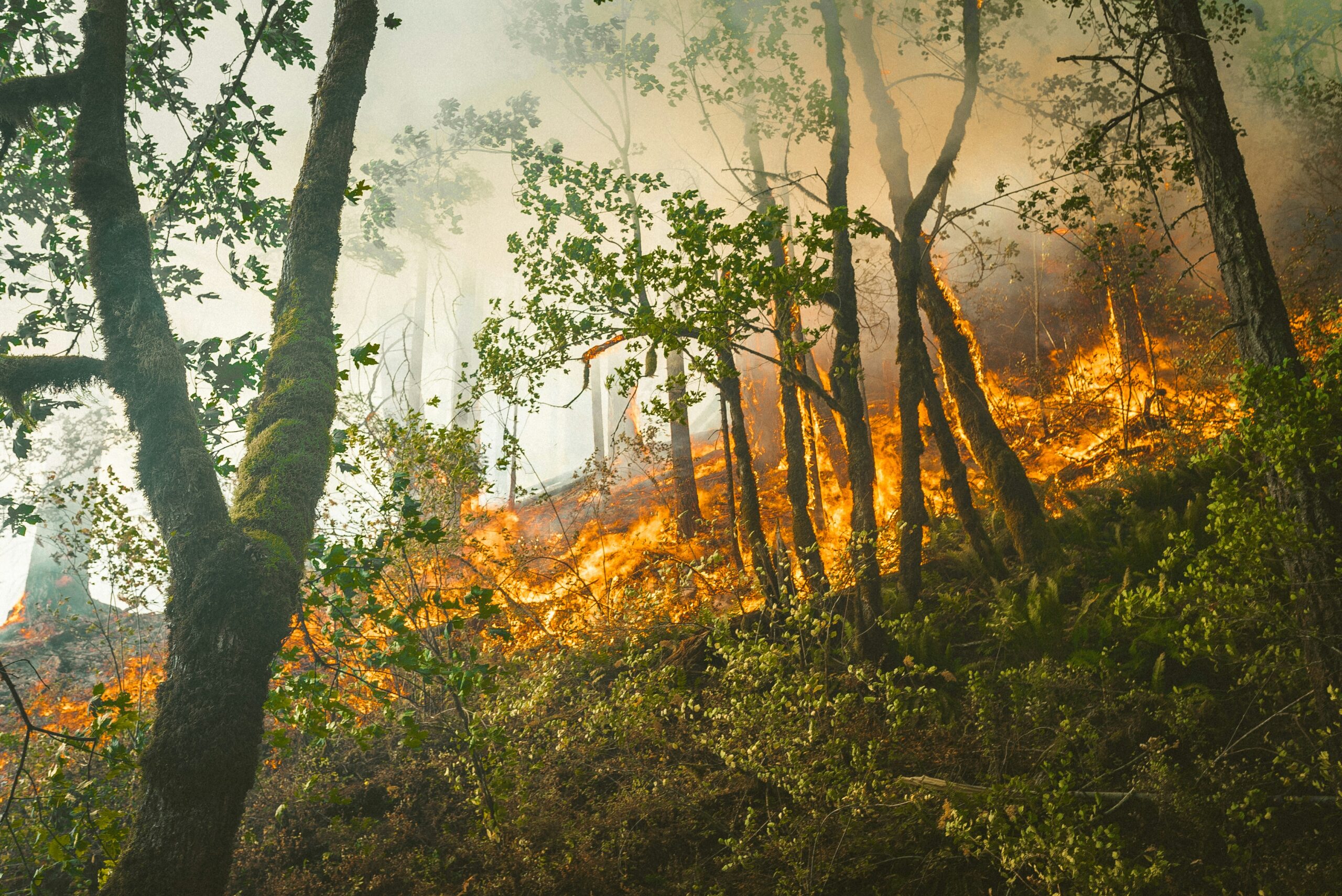
“Wildfires affecting more than 100,000 acres (megafires) are now so common that the National Interagency Fire Center “has stopped tracking them as exceptional events.”
–Adriana Petryna*
Welcome to sunny California.
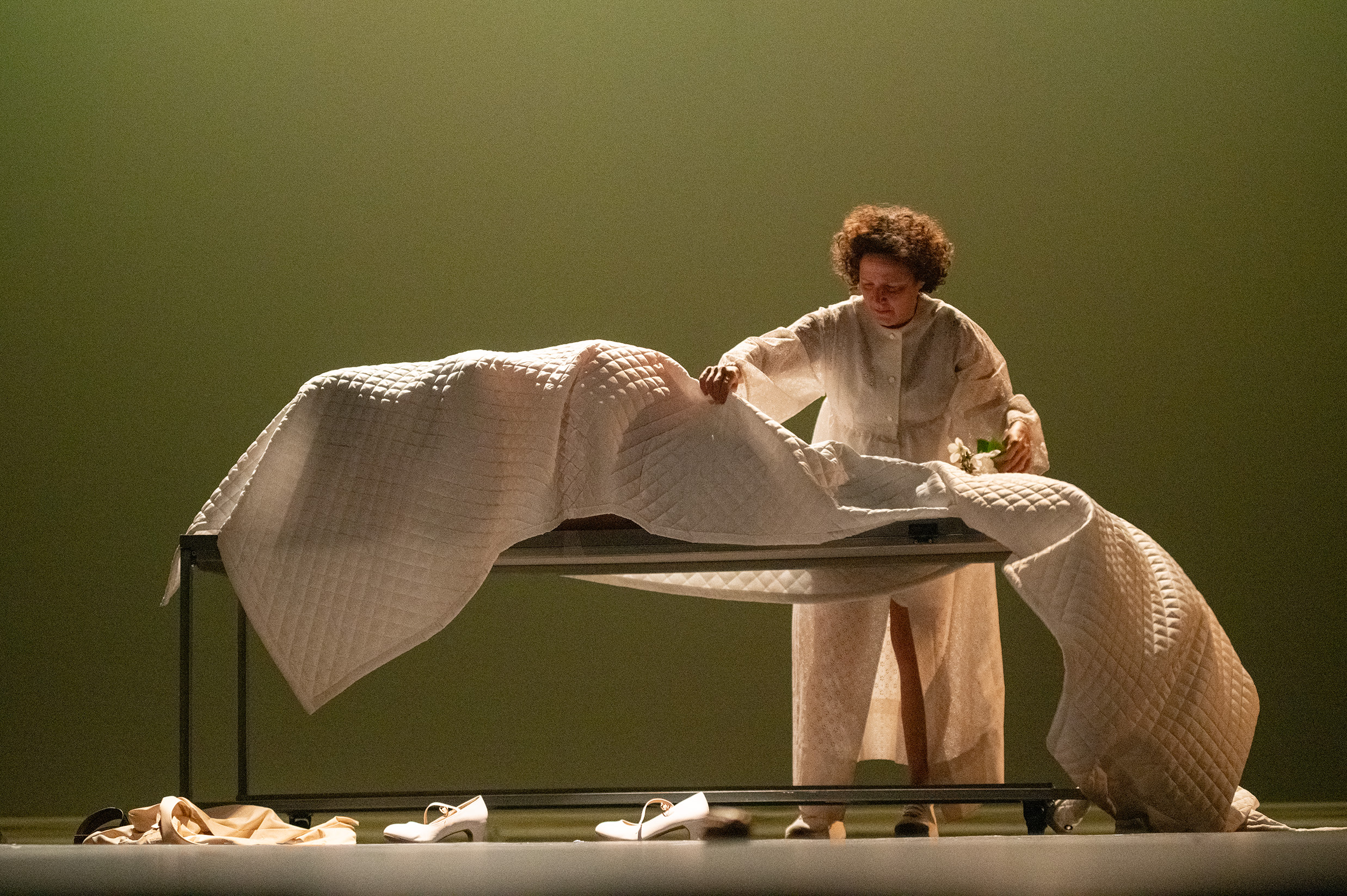
On stage with Burning Cauldron of Fiery Fire, where an intentional community is homesteading in an unnamed Northern California landscape, fire is confined to the visibly artificial. The sun rises and sets on plank-wood hills. Construction paper butterflies & dusty chalked redwood trees dot the walls at child-height. The raincoats never drip and despite bickering about ash, the smokeless woodstove’s door is always open. The conversation about humanity’s relationship to nature feels omnipresent; nature herself never enters the room. Instead, the cast becomes a ekphrasic chorus – turning the unseen landscape into a litany:
“A deer. Another deer. Artichokes, pumpkins. Thistles. Great Horned Owl.”
It’s a very familiar litany. These same lists populate the texts from my mother (blooming amaranth, morning fog, fox shit, baby skunks, the overflowing plum) and the memories of my childhood (Poison oak, fallen fir, ripe huckleberry, the Pleiades were out last night) in the same breathlessly remote Northern California hills as Cauldron’s homesteading community. The lists can’t convey the image, of course. Even with all the advantages of personal knowledge they only evoke blurred memory. Ekphrasic description rides a deliberate edge of failure, using language in a skidding, asymptotic approach to a visual it can’t possibly translate. The intentional reduction highlights what’s lost in translation – an evocation of art and artist and viewer all at once in place of a picture.
Cauldron’s choral lists see their foggy landscape through a frame of torn blue tarps and muddy boots and neverending small chores. Early on, the paternalistic Thomas (whose self-satisfied approach to patriarchal control through the language of radical freedom is also infuriatingly familiar) states with a vague & grandiose confidence that they run on no clock but that of mother nature – and of agriculture, a quick and airy conflation between the two. It’s Thomas whose voice introduces us to the death that begins the play. Somewhere between mourning and manifesto, he declaims: “A community sorrows together. A community gathers its dead and commends them to God.” In the skilled voice of Bruce McKenzie, I can hear Thomas declaring the shape of reality in real time. Faced with worlds, it’s very human to reduce them to words; to begin with words again to design new worlds, racing ahead of the raw edge of our own comprehension.
The old logging flat my mother has spent 50 years turning into a garden sits within easy distance of Cauldron’s California homestead. These particular golden hills are dotted with created spaces – a land group, a homestead, a commune, a tumble of overlapping definitions and brave new worlds. Just up the meadow and through the woods, my childhood best friend’s goat shed doubled as home base in tag and a roof for their land group’s worship on occasional Sundays. I grew up hearing comic, self-deprecating stories of young idealists learning the hard way: plywood roofs flying off in the first storm, recently-logged hillsides slumping into mud, the sheer impossibility of keeping the deer out of a tempting garden. We all knew, however (bitterer comedies, told later at night) that most of the crumbling was human.
It’s a complicated thing, to design an ecosystem.
“Hemlock. Creek. Eucalyptus. Goad Turds. Live Oak. Squash.
How many species of Coastal Pine?”
This is the litany of a second-growth forest.
If I say the word, can you picture a clearcut? Not a clearing, but a clearcut – hillside after hillside broken with logging, every tree & every bush shattered flat. After the logging (the wagons, the Gold Rush, the massacres) came a hundred years of artificial fire suppression-as-ecosystem-preservation in a landscape that evolved in flames. When I was a child in those rotary-phone California homesteads, there was no smoke season. Ten years ago my niece rolled her eyes in disbelief at having to show me how to put on an N95 mask. In January of this year fire tornados burned so hot they sterilized the ground. California entered the era of climate change as a tinder box.
“This forest would usually burn nine times over the course of 100 years, but no fire had blazed here since at least 1908.…. Before people started suppressing fires, this kind of all-consuming blaze did not happen.”
– Elizabeth Shogren**
The map is not the territory. When your careful design cracks under the infinite complexity of an organic ecosystem, do you adjust your design or reject the world? How much faith do you have in the completeness of your own comprehension?
Despite nightly grace, Cauldron’s brave new ecosystem feels predicated on extinguishing, rather than encountering, the ineffable. On stage, I watch the community create ritual after ritual inside the ripple effect of mortality. I watch Mari (partnered with Thomas) lock eyes with the other women and inhale briefly together during Thomas’s repeated rages at being confronted with an external reality. I watch the children learn to put their world into words – and use their new words to create new worlds again in a bright puppet show, reality translated and translated again into fantastical evocation. They can’t quite complete their show, however. They haven’t figured out the winch system.
By the end of the play, Mari has created a quiet memento mori of withered flowers mixed in with new blooms. Thomas has locked their only available phone in a gerbil cage marked ‘Strictly For The End Of The World’. A dead man is still dead. A pig is still alive. Every system contains mortality and mortality is incomprehensible.
Mom keeps sending lists (and, these days, blurry phone snapshots). Her messages make the ghosts of home rise up briefly around me – morning fog, wood fire smoke, November mushrooms, rotting apples, tanaok leaves, the ravens were talking this morning, they want their compost – although I couldn’t make you see those hills if I used the whole dictionary.✦
Quoted articles here:
* “Wildfires have changed. Firefighting hasn’t.” LA Times.
** “A Century of Fire Suppression Is Why California Is in Flames.” Mother Jones.
Extended Play is a project of The Civilians. To learn more about The Civilians and to access exclusive discounts to shows, visit us and join our email list at TheCivilians.org.