
From 2023 to 2025 I lived in Providence, Rhode Island, and began dreaming up a new play called Topia. Thanks to The Civilians, I was able to do research for my story at Princeton University, where I interviewed scientists to get up to date on climate science. But I also kept closely observing my adopted city. I knew I wanted to ground my play about climate change by telling a hyperlocal story with a unique sense of place.
Topia is about an estranged mother and her adult daughter who both, at different times, find themselves writing climate fiction. The mother, desperate for optimism, writes to imagine her daughter growing up and thriving in a healthier future edition of Providence. The daughter tries to grasp how dismal her mother’s world must have been, in a past she can’t quite imagine, for her mom to have given her up when she was little. I think Providence is the perfect setting for this story because 1) it’s kind of obscure, so it’s easy to get away with making stuff up about it, and 2) something about this punky, playful town inherently lends itself to wild imaginings and mythmaking. You can see this in the work of many artists and artisans who’ve come before me.
Here are some Providence artifacts that serve as portals into the (meta)fictional playworld I’m shaping.
1.
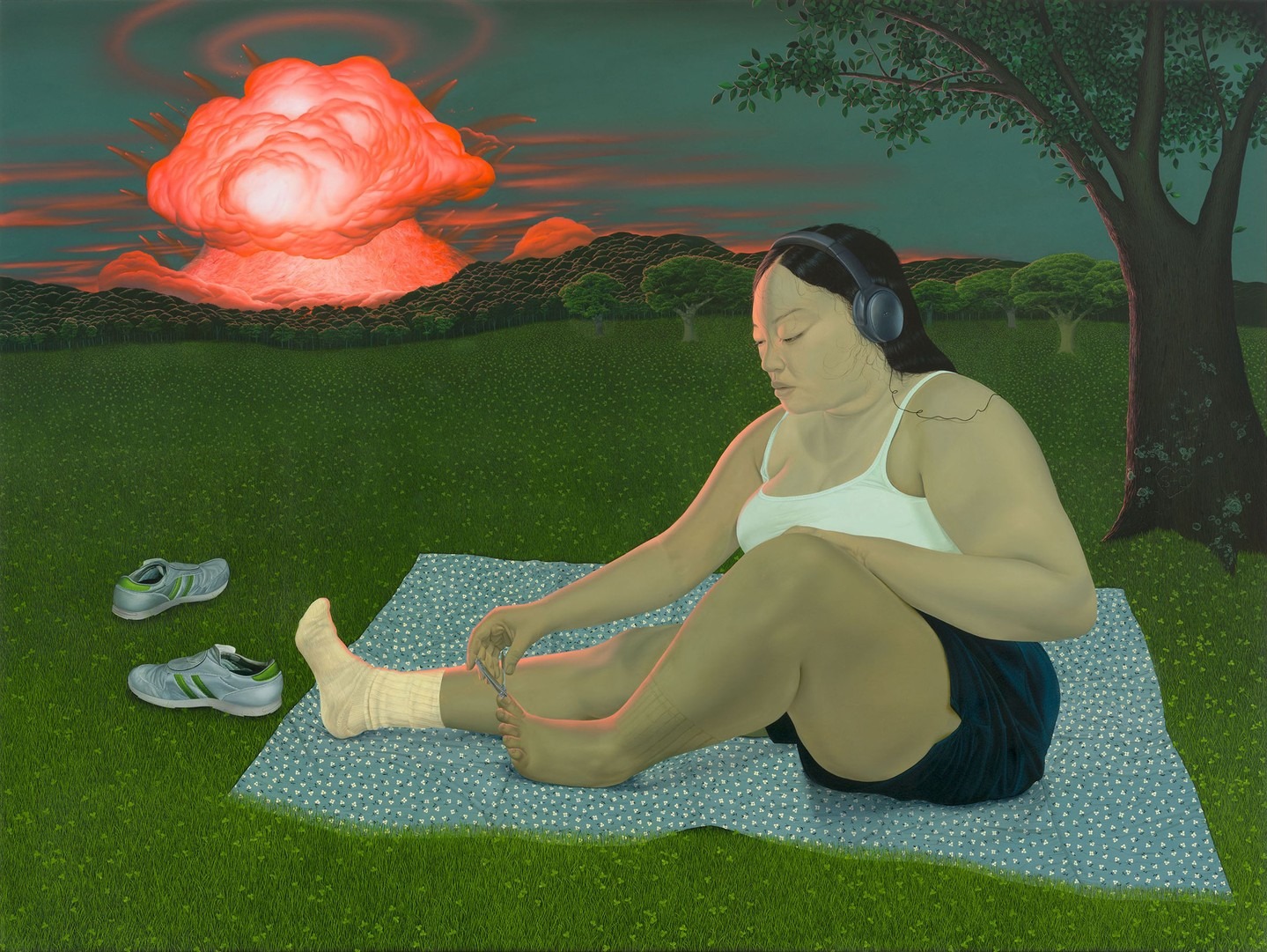
It Was Still Far Away by Sasha Gordon. Oil on linen. 2024.
What would Providence be without RISD? Or Brown, or Johnson & Wales… this is a University town. Many of the city’s fun, weird, indie businesses and restaurants were founded by local alums. Sasha Gordon is a recent RISD alum and now an art world star. She captured a tone with this image that’s somehow stifling and electric at the same time. It’s disquieting in the way I want my play to be. I’m not sure what feels more dangerous: The toenail clipping, the headphones, or the mushroom cloud in the background. It’s a nightmare scenario that still lets me contemplate human agency.
2.
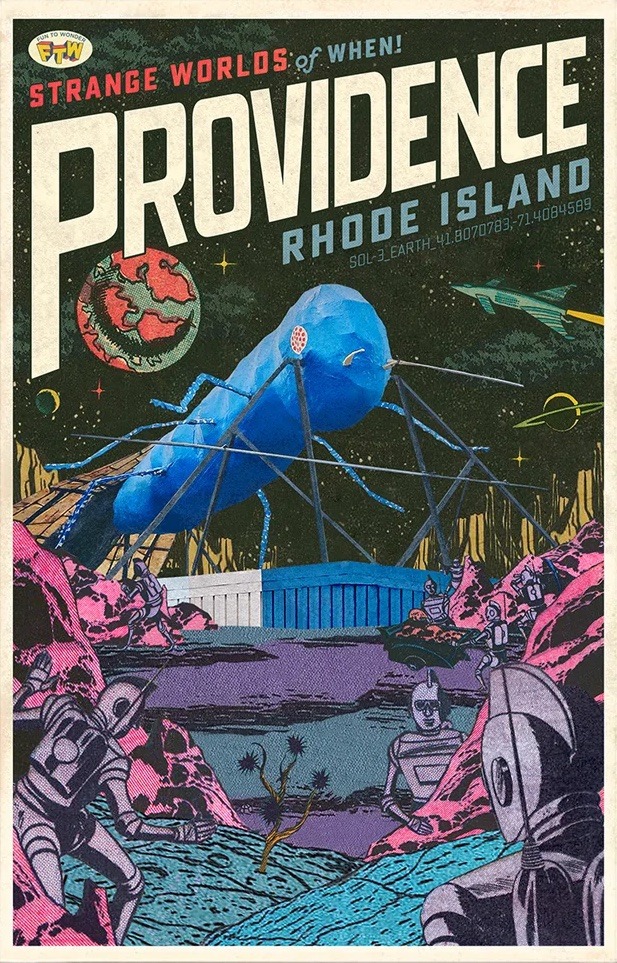
Big Blue Bug by Dan Freitas. 11 x 17 poster.
There is an actual Big Blue Bug in Providence. I’m not sure what I mean by “actual.” Where does reality end and dreaming begin? How does the architecture of a city determine your dreams, and in turn, your future reality? Nibbles Woodaway is a nine foot tall termite made of steel and fiberglass that lives on the roof of Big Blue Bug Solutions, a pest control company.
You can easily spot Nibbles from I-95; around Christmas he wears antlers, lights, and a glowing nose. This is a sci-fi poster made in response by Dan Freitas, another RISD alum, who created the local design shop Fun To Wonder. There’s maybe always been something inherently sci-fi about Providence.
3.
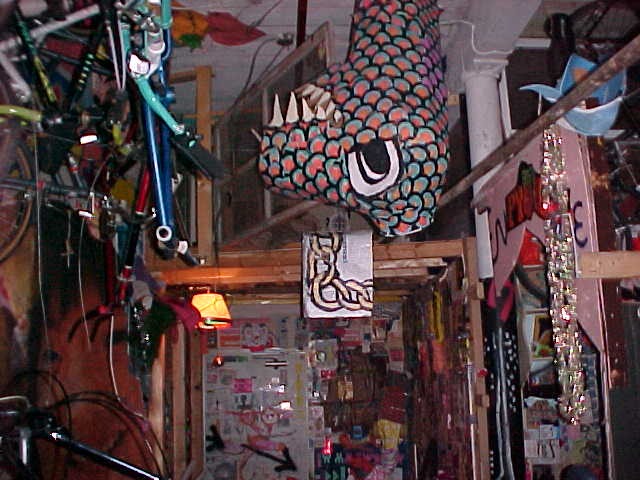
Fort Thunder. Converted 2nd floor of a former textile factory in the Olneyville district. 1995 – 2001. Photo via Warped Reality Magazine.
It feels absurd trying to pick one image to encapsulate Fort Thunder, a collective art project / living experiment / quasi-utopian living project. This was something that could only exist here, but also could only exist here during a certain time, which turned out to be, quite specifically: until the Providence Place Mall was erected.
In the 90s, Fort Thunder was a raucous home base for the local underground art/noise rock/alternative comics scene. Apparently, the only rule for living there was that you could make as much noise as possible and you had to be okay with that. I will refrain from telling you anything more and let you google it instead. Go watch Secret Mall Apartment and report back to me.
4.
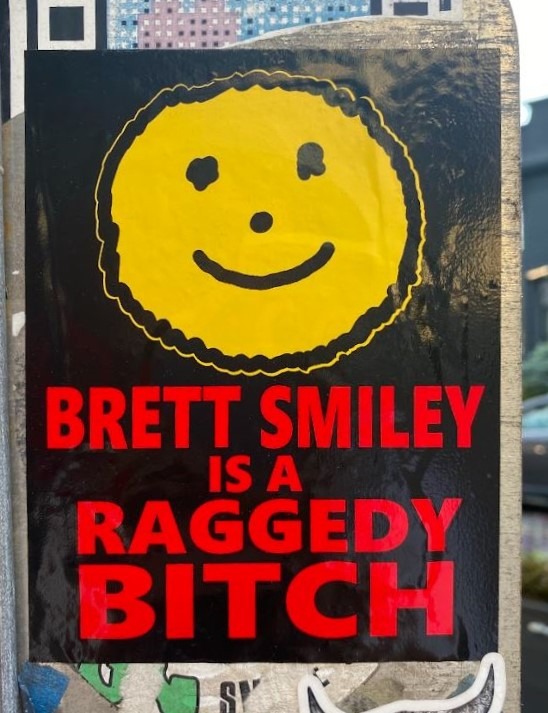
Street art. Sticker. Spotted ca. 2024.
Yes, the current Mayor’s name is Smiley. Feels like fiction but it’s true. From what I understand, these anonymous stickers channel anger about rent costs and city development that’s pushing out working-class residents.
There’s street art everywhere in Providence. Flyers for events and yard sales climb up and down every post. Often they’re hand drawn or decorated with something unexpected like pom poms. Perhaps nothing has shaped my Providence imaginary more than these proliferating signs and stickers.
5.
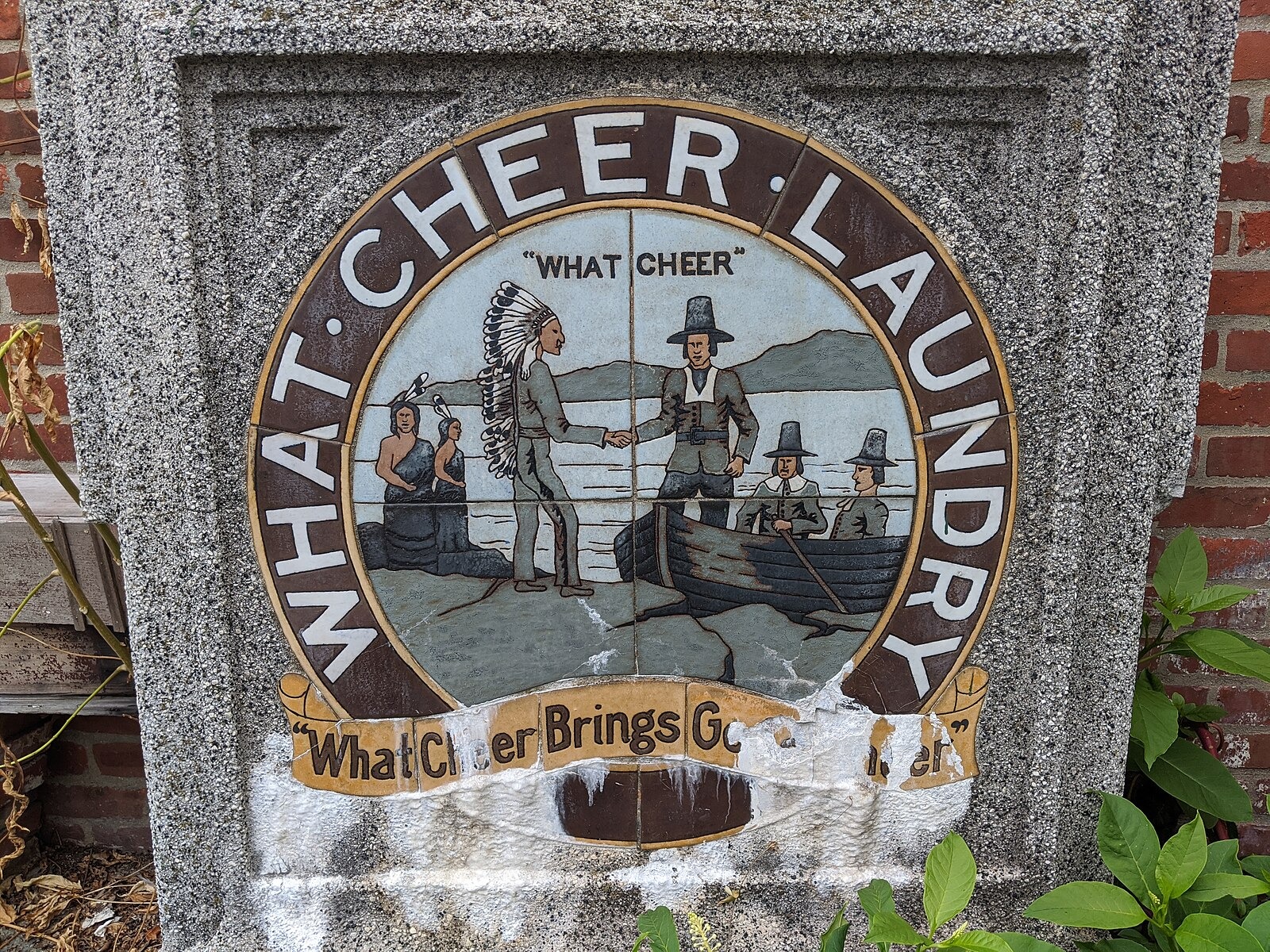
What Cheer Medallion at 93 Cranston Street (since removed). Painted tile. Year Unknown. Photo by UrbanDecayPVD via Wikipedia.
This image is a painting of the founding myth of this city. Here is the local legend: Roger Williams and some settler friends left the Massachussetts Bay Colony in 1636 in search of religious freedom (they had to leave; they were banished). After Roger crossed the Seekonk River, members of the Narragansett tribe welcomed him warmly with the words, “What Cheer, Netop?” (“What cheery news have you brought, friend?”)
How will I incorporate Providence’s colonial history and historical mythmaking into my play? This image, in its cartoon-like simplicity, makes me uncomfortable and curious. It’s also ubiquitous around town. Many businesses in Providence are named What Cheer, including the former Steam Laundry Company, which was a major employer. It even says What Cheer on the trashcans.. Side note: There’s a separate legend that Roger Williams’ body turned into the root of an apple tree after he died. You can visit the root to this day.
6.
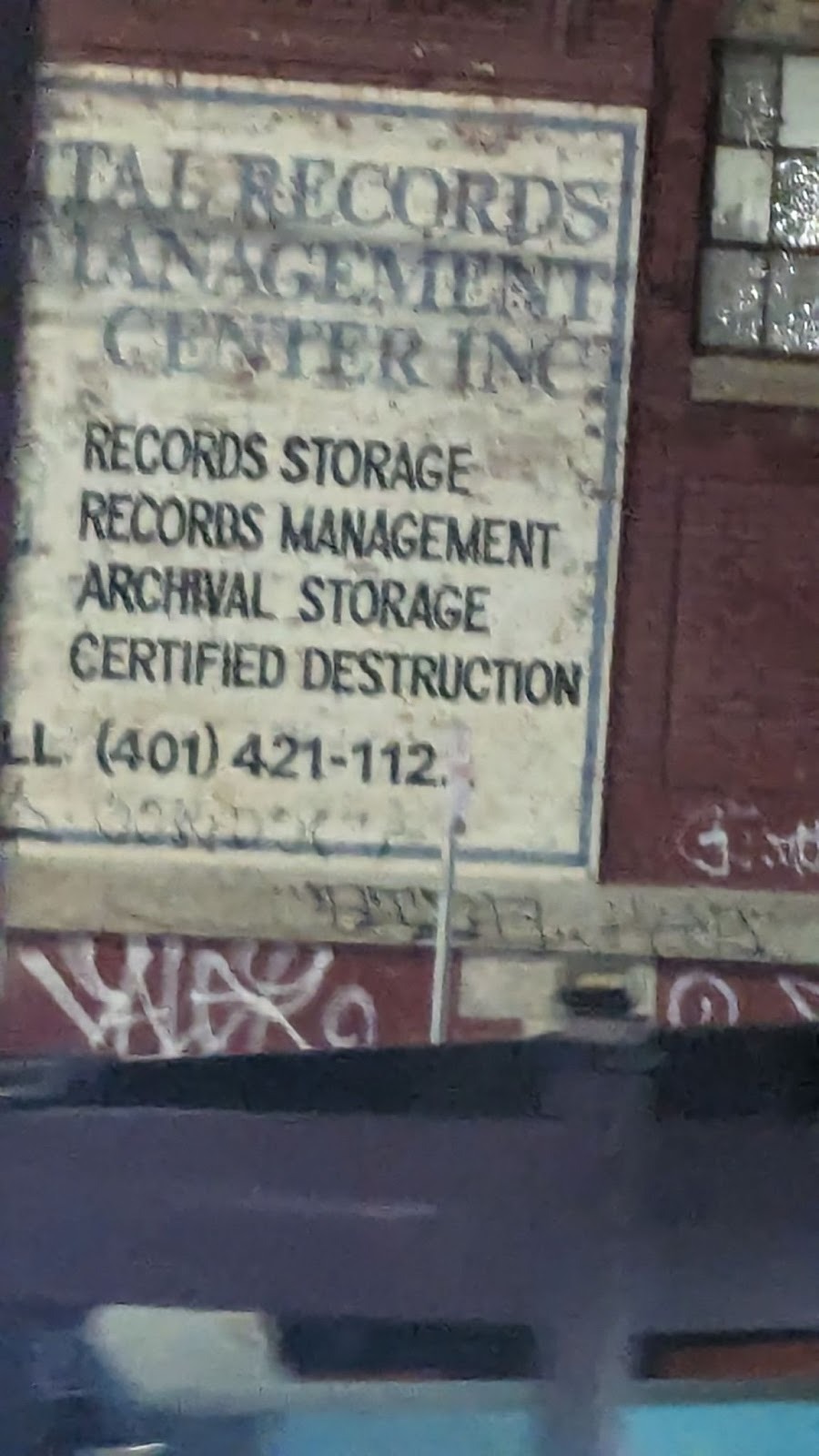
Vital Records Management Center. Photo of a wall painting taken by me in 2024.
I don’t know where exactly I snapped this picture. (It’s blurry because I took it from the passenger side of a car.) This seems to be an advertisement for a bygone company. I wonder when it’s from. I wonder what records were certified destroyed while others were archivally stored. Now this advertisement is its own kind of archive. Times being what they are, this image is evocative for me of our present. 2025 has been a landmark year for the scrubbing of environmental data and climate science from U.S. government websites (among other intentional disappearing of viewpoints, words, and persons).
Independent archivists are doing their best to duplicate essential records before they disappear with little to no warning. To what extent is the internet a trustworthy archive? Will the words I’m putting here ever be censored? How much am I self-censoring in an effort to not be censored? Will these thoughts disappear as technologies keep changing?
7.
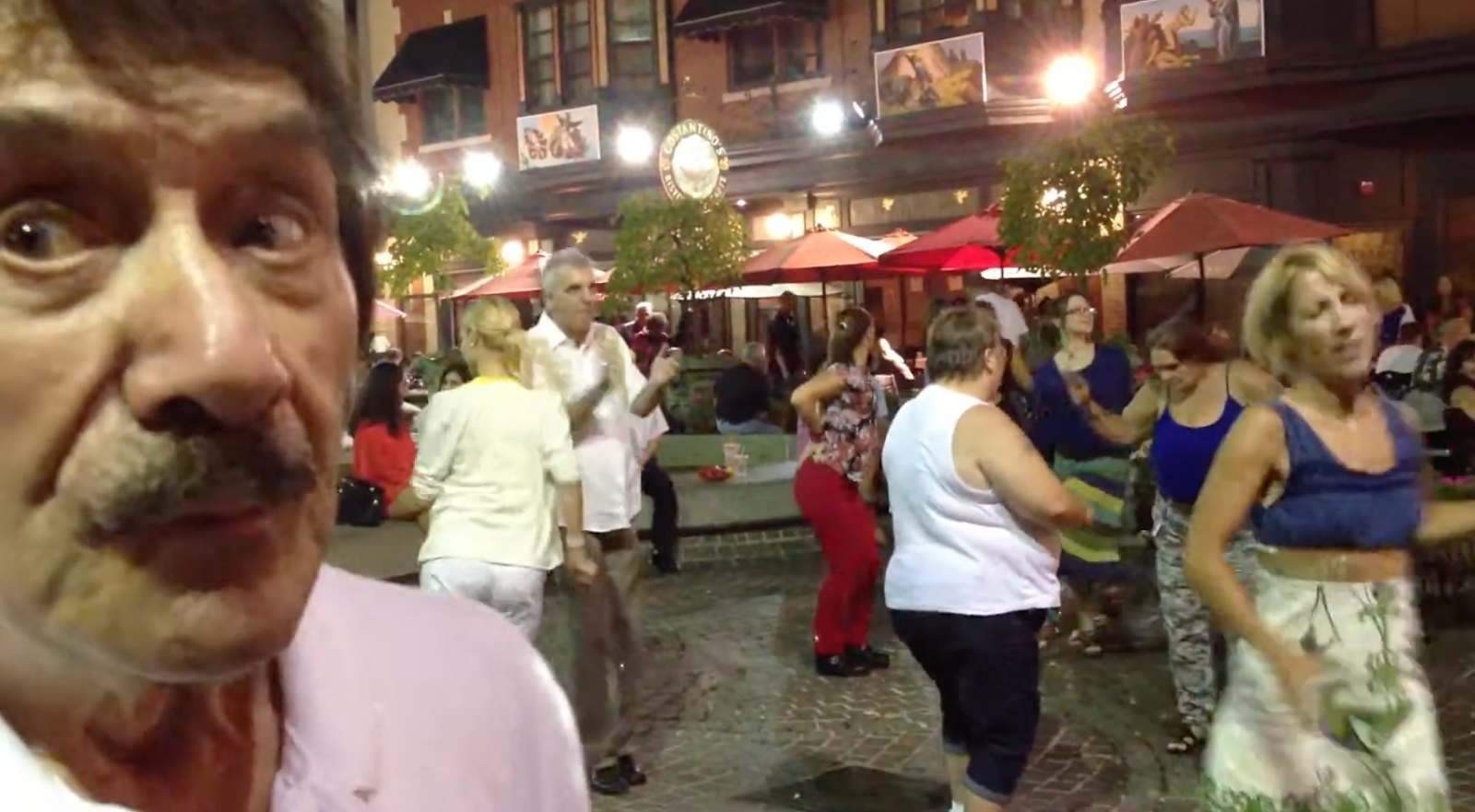
Dancing on Federal Hill Summer 2012 by Kurt Kern. YouTube video.
In writing and researching this play, I’m searching for reasons to stay hopeful, and by extension, to keep pursuing a viable climate future despite formidable political and cultural obstacles. (“Fuck hope. What’s the strategy?” said Ayana Elizabeth Johnson recently, and I don’t totally disagree. Strategy gives me the most hope.)
Anyway, I refuse to end this essay on a downbeat note and instead give you: people dancing. This video is a glimpse into someone else’s memories, not mine. But I have this video saved in a private “Topia” playlist because it intertwines with my summers of ‘23 and ‘24.
There’s a cobblestoned plaza in Providence’s Little Italy with a bounteous fountain. On a warm night you’ll find tourists and locals sipping Aperol Spritz and slurping pasta. If you’re lucky, a dapper Italian-American man will be crooning and some brave souls will choose to dance. I hope you’ll feel mysteriously charmed and grateful to be alive.
Extended Play is a project of The Civilians. To learn more about The Civilians and to access exclusive discounts to shows, visit us and join our email list at TheCivilians.org.